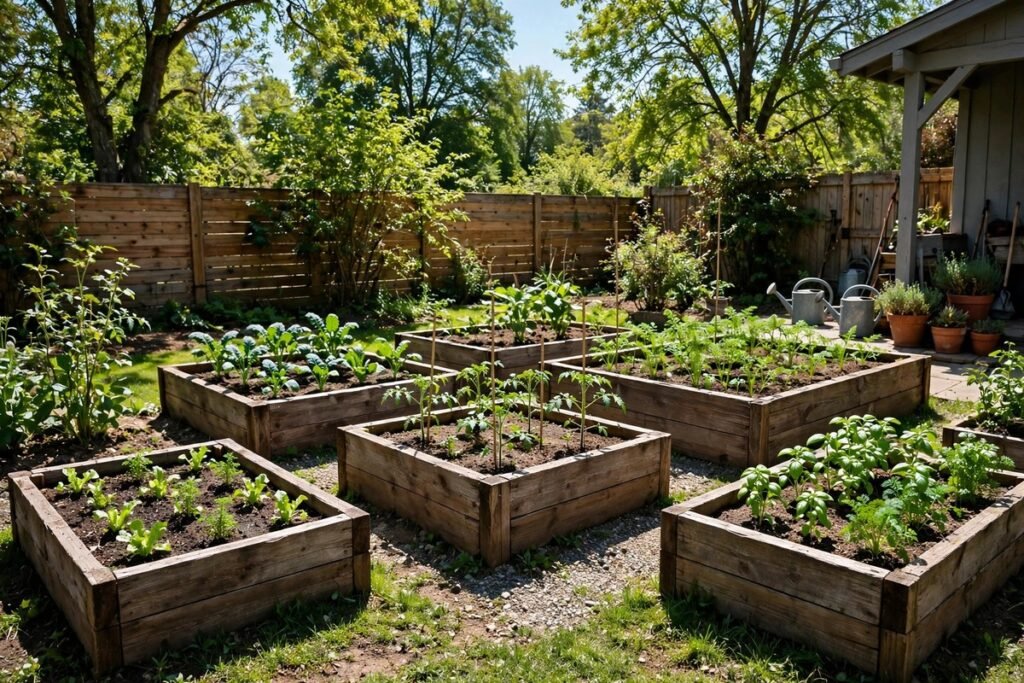
square foot garden bed sizes run from a 2×4 bed with 8 squares to a 4×8 bed with 32 squares. A 3×3 bed has 9 squares and a 4×4 bed has 16 squares. A 4×4 bed suits most gardeners because it is reachable from any side. A 4×8 bed holds twice as much but needs access from both long sides.
How the grid formula works
Square foot gardening divides a bed into 1 ft by 1 ft squares, or 30 cm by 30 cm in metric beds. Grid squares equal floor of length divided by square size, times floor of width divided by square size. Floor means round down. Plants per crop equal squares times plants per square. Free squares equal grid squares minus squares planned.
Use the Square Foot Garden Planner to enter bed size, list up to six crops, set squares per crop and plants per square, then check the grid and the free squares. It warns you if you have planned more squares than the bed holds.
Densities are perfect squares only: 1 for large plants, 4 for medium plants, 9 for small plants and 16 for very small plants. At 12 inch spacing you fit 1 plant per square, at 6 inch spacing 4, at 4 inch spacing 9, and at 3 inch spacing 16. A density that is not 1, 4, 9 or 16 does not fit in neat rows inside one square.
Bed sizes at a glance
The table below gives the grid count and the plant total for each size, if the whole bed were planted at one density.
| Bed size | Grid squares | At 1 per square | At 4 per square | At 9 per square | At 16 per square |
|---|---|---|---|---|---|
| 2×4 ft | 8 | 8 | 32 | 72 | 128 |
| 3×3 ft | 9 | 9 | 36 | 81 | 144 |
| 4×4 ft | 16 | 16 | 64 | 144 | 256 |
| 4×8 ft | 32 | 32 | 128 | 288 | 512 |
Check the largest bed first. Tomatoes at 1 per square give 32 plants in a 4×8 bed, not 8. Bush beans at 9 per square give 288 plants in the same bed, not 128.
What each density means
The table below links each density to the crops named on the calculator page.
| Plants per square | Plant size | Calculator crops |
|---|---|---|
| 1 | Large | Tomato, pepper |
| 4 | Medium | Lettuce, chard, basil |
| 9 | Small | Bush beans, spinach |
| 16 | Very small | Carrots, radishes |
Real plans mix densities. The calculator worked example for a 4×4 bed uses two tomato, two pepper, four lettuce, three bush bean, two carrot and three basil squares, for 16 squares and 91 plants, with 0 free squares. Vining crops need a trellis to fit one or two per square. Tall crops go on the side that will not shade the rest of the bed.
2×4 bed: 8 squares for a narrow space
A 2×4 bed has 8 squares, from 2 times 4 equals 8. It suits a narrow space where a wider bed will not fit, such as a strip beside a path. The bed is only 2 ft wide, so you can reach the centre from either long side.
The limit is crop range. Two squares each of tomatoes, lettuce, bush beans and carrots fill the bed with 60 plants, but leave no room for a second sowing. About 15 cm is the traditional minimum depth, and 30 cm gives more room for roots.
3×3 bed: 9 squares in a compact square
A 3×3 bed has 9 squares, from 3 times 3 equals 9. It holds one more square than a 2×4 bed, in a compact shape that suits a small patio corner. The centre square is 1.5 ft from any edge, so you can reach it from any side without stepping on the soil.
A mixed plan could use two squares of peppers, three of lettuce, two of spinach and two of radishes. Squares total 9 and plants total 64, with 0 free squares. That leaves no room for tomatoes, bush beans or carrots in the same bed.
4×4 bed: 16 squares and the classic size
A 4×4 bed has 16 squares, from 4 times 4 equals 16. The calculator page calls 4×4 ft, which is 1.2 m by 1.2 m, the classic size, because you can reach the middle from any side without stepping on the soil. An adult arm can reach about 2 ft from the edge, so a 4 ft bed puts the centre within 2 ft of every edge.
A 4×4 bed suits most gardeners because it balances size and reach. It is large enough for six crops, which is the planner limit. If you plan 10 squares, free squares equal 16 minus 10, which is 6, space for a later sowing. Use the Plant Spacing Calculator to check spacing before you commit a square.
4×8 bed: 32 squares and twice the 4×4 bed
A 4×8 bed has 32 squares, from 4 times 8 equals 32. It is exactly twice a 4×4 bed, because 32 is 2 times 16. At 1 per square it gives 32 plants, at 4 per square 128 plants, at 9 per square 288 plants, and at 16 per square 512 plants.
Reach is the key difference. A 4×8 bed is still 4 ft wide, so the centre is within 2 ft of a long edge, but the bed is 8 ft long. You cannot reach the middle of the length from a short end. You need access from both long sides. Against a wall, a smaller bed, or two 4×4 beds with a path between them, will be easier to tend.
A mixed planting plan for a 4×8 bed
The table below gives one mixed plan for a 4×8 bed that totals exactly 32 squares. It uses six crops, which is the planner limit, and only crops and densities named on the calculator page.
| Crop | Squares | Plants per square | Plants |
|---|---|---|---|
| Tomato | 4 | 1 | 4 |
| Pepper | 4 | 1 | 4 |
| Lettuce | 6 | 4 | 24 |
| Bush beans | 6 | 9 | 54 |
| Carrots | 6 | 16 | 96 |
| Basil | 6 | 4 | 24 |
| Total | 32 | 206 |
Squares total 32 and plants total 206, with 0 free squares. Put tomato and pepper, the tall crops, on the side that will not shade the rest of the bed. If you want a fast crop later, leave one or two squares free at the start.
How to choose your size
Choose by space first, then by reach, then by crop range. Measure the space and the paths around it before you choose. A 4×8 bed needs a path on both long sides.
Test reach with your own arm. A 4 ft width works when both long sides are open, a 3 ft width works when access is limited, and a 2 ft width works when access is from one side only. A 2.5 ft width gives only 2 full squares per row and wastes 0.5 ft in every row.
Then count squares for the crops you want. Add the squares, and compare the total with the grid count. If the total exceeds the grid, choose a larger bed or drop a crop. The Raised Bed Soil Calculator can help you plan the fill for the bed size you choose. Do not guess at a plants per square figure for a crop that is not on the calculator page.
Common mistakes that waste squares
- Choosing a bed wider than 4 ft, then stepping on the soil to reach the centre.
- Placing a 4×8 bed against a wall, so the far long side has no access.
- Using a density that is not 1, 4, 9 or 16, such as 6 or 8 per square.
- Using bush beans at 4 per square instead of 9 per square.
- Using tomatoes at 1 per 4 squares instead of 1 per square.
- Planning more squares than the bed holds.
- Filling every square at the start, with no free squares for a later sowing.
- Putting tall crops in the middle, where they shade shorter crops.
- Using a 2.5 ft width and losing a partial square in every row.
- Copying a competitor volume total for a filled bed without checking it.
Frequently asked questions
Q: What is the best square foot garden bed size?
A: A 4×4 bed is the classic size, with 16 squares and reach from any side. A 2×4 bed suits a narrow space, a 3×3 bed suits a compact space, and a 4×8 bed suits a larger crop with paths on both long sides.
Q: How many squares are in a 4×8 square foot garden bed?
A: A 4×8 bed has 32 squares. At 1 per square it gives 32 plants, at 4 per square 128 plants, at 9 per square 288 plants, and at 16 per square 512 plants.
Q: How many tomato plants fit in a 4×8 square foot garden bed?
A: A 4×8 bed holds 32 tomato plants at 1 per square. A claim of 8 tomatoes is wrong, because it uses 1 tomato per 4 squares instead of 1 per square.
Q: How many bush bean plants fit in a 4×8 square foot garden bed?
A: A 4×8 bed holds 288 bush bean plants at 9 per square. A claim of 128 bush beans is wrong, because it uses 4 bush beans per square instead of 9 per square.
Q: Why is 4 ft the classic width for a square foot garden bed?
A: A 4 ft width puts the centre within 2 ft of every edge, so you can reach the middle from any side without stepping on the soil. A wider bed puts the centre beyond easy reach.
Q: Can I put a 4×8 bed against a wall?
A: You can, but it is not a good choice, because a 4×8 bed needs access from both long sides. Against a wall the far side is hard to reach, so a smaller bed or two 4×4 beds with a path between them will be easier to tend.
More guides

How to Choose a Fertilizer Rate: Meet Nitrogen or Cap Every Nutrient
Learning how to choose a fertilizer rate starts with one choice. You either meet a chosen nutrient target, usually nitrogen, and accept…
Read guide
Too Much Phosphorus From Fertilizer: Surplus, Signs and Fixes
Too much phosphorus from fertilizer is a surplus that appears when a balanced blend meets nitrogen and supplies twice the phosphate the…
Read guide
Fertilizer NPK Numbers Explained: What N, P2O5 and K2O Mean
Fertilizer npk numbers are the three percentages on a fertilizer bag, listed in the order nitrogen, phosphate and potash. They tell you…
Read guide