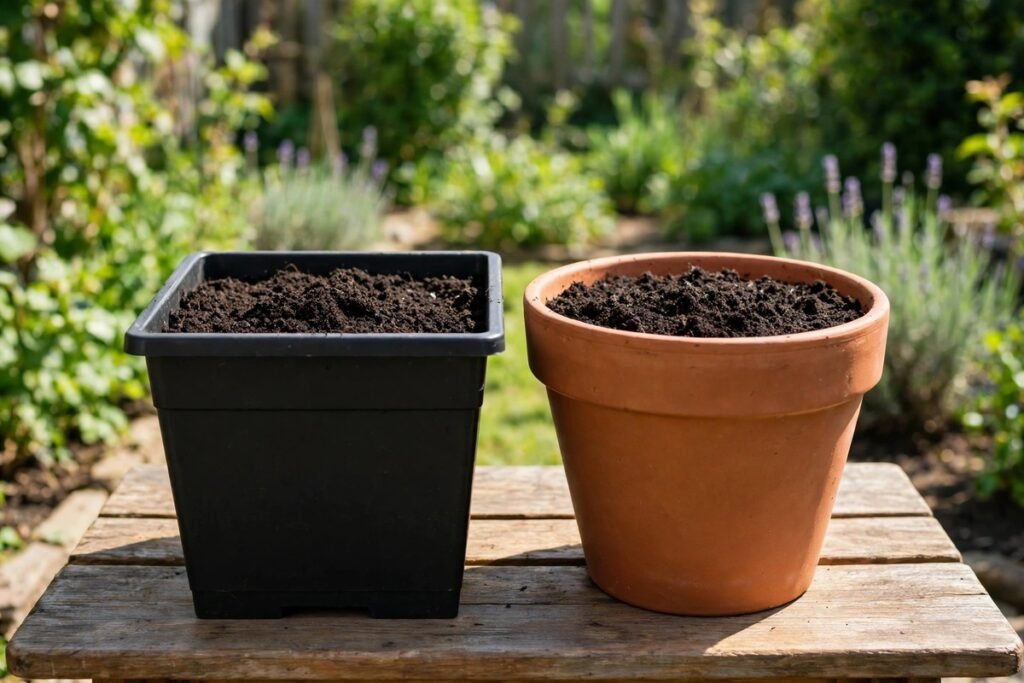
Square vs Round Pots: How Much Potting Soil Each Needs
A square pot holds about 27 percent more potting soil than a round pot of the same top width and depth. At 30 cm across the top and 28 cm deep, a square pot needs 21.61 litres at full fill, while a round pot needs 16.97 litres. At 90 percent fill, the figures are 19.45 litres and 15.27 litres.
Use the Potting Soil Calculator to run your exact pots, shapes and bag size.
Why shape changes the volume
Two pots can look the same size from above and still need very different amounts of potting soil. The shape below the top edge decides the rest. A round pot has a circular cross section. A square pot has a square cross section. At the same top width, the square covers more area than the circle. A circle drawn inside a square leaves four empty corners. A square pot uses those corners. A round pot does not.
The formulas for a tapered pot
Most pots taper, so the top is wider than the base. A pot with that shape is a frustum, a cone or a pyramid with the point cut off. The calculator uses a base of 0.85 times the top width, typical for nursery style pots.
Round pot volume = pi x depth x (top squared + top x base + base squared) / 12. Square pot volume = depth x (top squared + top x base + base squared) / 3. Base = 0.85 x top. The bracket is the same for both shapes. Pi divided by 12 is 0.2618 and 1 divided by 3 is 0.3333, a ratio of 1.27.
Soil = sum(pots x pot volume x fill percent) x (1 + extra percent). Bags = ceil(soil / bag size). Ceil means round up to the next whole bag. This article uses 90 percent fill and no extra percent.
The frustum working at 30 cm step by step
Use a 30 cm pot, 28 cm deep, a 12 inch pot about 11 inches deep.
Base = 0.85 x 30 = 25.5 cm. The base is 4.5 cm narrower than the top.
Bracket: top squared = 30 x 30 = 900. Top x base = 30 x 25.5 = 765. Base squared = 25.5 x 25.5 = 650.25. Total = 900 + 765 + 650.25 = 2315.25. This total is the same for both shapes.
Round pot: pi x 28 x 2315.25 / 12. First, 28 x 2315.25 = 64827. Next, 64827 / 12 = 5402.25. Next, 5402.25 x pi = 16971 cubic centimetres. Divide by 1000 to get 16.97 litres at full fill.
Square pot: 28 x 2315.25 / 3. First, 28 x 2315.25 = 64827. Next, 64827 / 3 = 21609 cubic centimetres. Divide by 1000 to get 21.61 litres at full fill.
At 90 percent fill: round, 16.97 x 0.9 = 15.27 litres. Square, 21.61 x 0.9 = 19.45 litres. Compare them: 21.61 / 16.97 = 1.27. The difference is 4.64 litres at full fill and 4.18 litres at 90 percent fill.
Why a tapered pot holds less than a straight sided box
The top width is the widest point only. It does not tell you the width at the base. A tapered pot is narrower lower down, so it holds less than a straight sided box of the same top width and depth.
Straight sided square box, 30 cm by 30 cm by 28 cm: 30 x 30 x 28 = 25200 cubic centimetres = 25.2 litres. The tapered square pot holds 21.61 litres, 3.59 litres less.
Volume table at four sizes
All volumes use the same 0.85 taper. Use the 90 percent fill column for buying, unless you plan to fill a pot right to the rim, which leaves no room for watering.
| Top width and depth | Round pot full | Round pot at 90 percent | Square pot full | Square pot at 90 percent |
|---|---|---|---|---|
| 20 cm x 18 cm | 4.85 L | 4.36 L | 6.17 L | 5.56 L |
| 25 cm x 22 cm | 9.26 L | 8.33 L | 11.79 L | 10.61 L |
| 30 cm x 28 cm | 16.97 L | 15.27 L | 21.61 L | 19.45 L |
| 40 cm x 35 cm | 37.71 L | 33.94 L | 48.02 L | 43.22 L |
What 27 percent more means in practice
One square pot at 30 cm needs 4.18 litres more than one round pot. Six square pots need 25.08 litres more than six round pots, because 4.18 x 6 = 25.08. The percentage is the same at every size: 6.17 / 4.85 = 1.27, 11.79 / 9.26 = 1.27, and 48.02 / 37.71 = 1.27.
Bag counts for 6 square pots versus 6 round pots
Use 40 L bags, 30 cm pots at 28 cm deep, and 90 percent fill, with no extra percent added. Round the bag count up in every case.
6 square pots: 6 x 19.45 = 116.7 litres. 116.7 / 40 = 2.9175. Ceil(2.9175) = 3 bags. That gives 120 litres, leaving 3.3 litres spare.
6 round pots: 6 x 15.27 = 91.62 litres, rounded to 91.6 litres. 91.6 / 40 = 2.29. Ceil(2.29) = 3 bags. That gives 120 litres, leaving 28.4 litres spare.
Both sets need 3 bags, even though the square set needs 25.1 litres more soil. Rounding up to whole bags hides that difference here.
A 40 L bag fills about two and a half round pots at 30 cm, because 40 / 15.27 = 2.62, and about two square pots, because 40 / 19.45 = 2.06.
A mixed set example
Add each shape separately. Do not average the two shapes, and do not use one shape for the whole set. Add the square total and the round total, then divide by the bag size and round up.
Example 1: 3 square pots and 3 round pots, all 30 cm and 28 cm deep, at 90 percent fill. Square: 3 x 19.45 = 58.35 litres. Round: 3 x 15.27 = 45.81 litres. Total: 58.35 + 45.81 = 104.16 litres. 104.16 / 40 = 2.604. Ceil(2.604) = 3 bags, leaving 15.84 litres spare.
How to measure your pot
Measure the inside of the pot, not the outside. The outside width includes the wall and the rim, and it will overstate the volume. Measure across the top opening from one inside wall to the other, and measure the depth from the inside base to the rim. A 30 cm pot is about 12 inches across the top. If your pot is straight sided, use the Garden Volume Calculator for a box shape. See the Royal Horticultural Society guide to growing plants in containers.
Common mistakes in a square versus round calculation
Using a round figure for a square pot. A 30 cm round pot and a 30 cm square pot share a top width, not a volume.
Using a straight sided formula for a tapered pot. A straight sided square box at 30 cm holds 25.2 litres, while the tapered square pot holds 21.61 litres.
Rounding down the bags. Always round up.
Averaging square and round pots in a mixed set. The average of 19.45 and 15.27 is 17.36 litres. Add each shape separately.
Measuring the outside of the pot. Use the inside width, or the soil figure will be too high.
Choosing square or round pots
Square pots sit side by side with no gaps, which matters on a small patio or balcony. Round pots are easier to turn, move and clean. If you plan a row of square pots, the Square Foot Garden Planner can help you plan the spacing for the plants in them.
Frequently asked questions
Q: How much potting soil does a square pot need compared with a round pot?
A: About 27 percent more. At 30 cm and 28 cm deep, a square pot needs 21.61 litres at full fill and 19.45 litres at 90 percent fill, while a round pot needs 16.97 litres at full fill and 15.27 litres at 90 percent fill.
Q: How much potting soil do I need for 6 square pots at 30 cm?
A: 116.7 litres at 90 percent fill, because 6 x 19.45 = 116.7. Divide 116.7 by 40 to get 2.9175, and ceil(2.9175) = 3 bags of 40 L.
Q: How much potting soil do I need for 6 round pots at 30 cm?
A: 91.6 litres at 90 percent fill, because 6 x 15.27 = 91.62, rounded to 91.6. Divide 91.6 by 40 to get 2.29, and ceil(2.29) = 3 bags of 40 L. The square set leaves only 3.3 litres spare, while the round set leaves 28.4 litres spare.
Q: Why does a square pot hold more soil than a round pot of the same width?
A: A square cross section covers more area than a circle of the same width, because the circle leaves four empty corners inside the square. The ratio is fixed at about 1.27, so a square pot holds about 27 percent more at every size in the table.
Q: Why does a tapered pot hold less soil than a straight sided pot?
A: A tapered pot is narrower at the base, so the sides slope inward. A straight sided square box at 30 cm holds 25.2 litres, while the tapered square pot holds 21.61 litres. A straight sided round cylinder holds 19.79 litres, while the tapered round pot holds 16.97 litres.
Q: How many 40 L bags do I need for a mixed set of square and round pots?
A: Add each shape separately, then divide by 40 and round up. For 3 square pots and 3 round pots at 30 cm and 90 percent fill, the total is 104.16 litres, and ceil(104.16 / 40) = 3 bags.
Measure the top width and the depth, read the right shape from the table, add each shape separately, and round the bags up. Run your exact pots through the Potting Soil Calculator before you buy, and check the garden guides.
More guides
How Many Zones Does My Supply Need
If you are asking how many zones does my supply need, the answer comes from two numbers. Add up the flow of…
Read guide
Head to Head Coverage Explained: Spacing, Corners, Edges and Middle
Head to head coverage means each sprinkler head sprays far enough to reach the head next to it, so the distance between…
Read guide
How Many Sprinkler Heads Do I Need
How many sprinkler heads do I need depends on lawn size and throw radius. A 10 by 6 metre lawn with 4…
Read guide