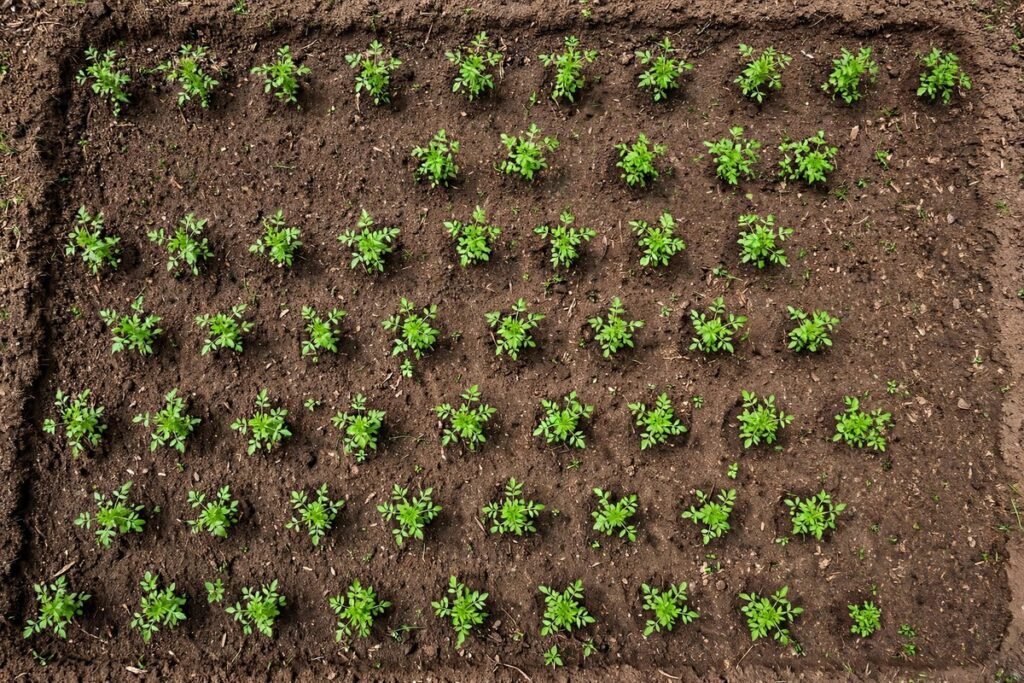
The question of square vs triangular plant density compares two layouts at the same spacing. At 15 cm spacing, a square grid holds 44.44 plants per square metre. A triangular layout holds 51.32 plants per square metre at the same spacing. The triangular gain is 15.47 percent, so it fits about 15 percent more plants in the same area.
Density is a rate, not a count for one named area. It tells you how many plants fit in each square metre or each square foot when the spacing stays the same and only the pattern changes. Once you know the density, you can work out an order quantity by multiplying the density by the area and rounding down. The Plants per Square Foot Calculator does that calculation for you.
The square formula is density equals 1 divided by spacing squared. The triangular formula is density equals 1.1547 divided by spacing squared. The total for an area is floor of area times density, where floor means round down to a whole plant.
Why the two densities differ
A square grid is the simplest pattern. Plants sit in straight rows and straight columns, with the same spacing in both directions. Each plant gets a square patch of ground. At 15 cm spacing, each plant gets 15 cm times 15 cm, which is 225 square cm. One square metre holds 10000 square cm, so the density is 10000 divided by 225, which is 44.44 plants per square metre.
A triangular layout shifts every other row sideways by half a spacing. Each plant then sits in the gap between two plants in the row in front of it. The rows move closer together, so each plant gets a smaller patch, 194.9 square cm at 15 cm spacing. One square metre therefore holds 10000 divided by 194.9, which is 51.32 plants per square metre. The gain is 15.47 percent at every spacing.
Where 1.1547 comes from
The number 1.1547 comes from a simple triangle. In a triangular layout, each plant and its two nearest neighbours in the next row form a triangle with three equal sides. Each side is the spacing, and the height is the distance between rows.
The square root of 3 is about 1.732. Divide 2 by 1.732 and the result is about 1.155, which the calculator gives more precisely as 1.1547. It is 2 divided by the square root of 3. The square root of 3 divided by 2 is about 0.866, so rows are 0.866 times the spacing apart. At 15 cm spacing, rows are 13.0 cm apart.
The six neighbours in plain words
On a square grid, each plant has four nearest neighbours at the spacing distance: one in front, one behind, one to the left and one to the right. The four diagonal neighbours are farther away, at about 1.414 times the spacing.
On a triangular layout, each plant has six nearest neighbours, all at the spacing distance. One sits to the left and one to the right in the same row. Two sit in the row in front, and two more sit in the row behind. Together they form a ring around the central plant.
That ring is why the pattern packs tighter. The next row sits in the gaps of the row in front, so rows move closer without any two plants getting closer than the spacing.
Density at common metric spacings
The table below gives density per square metre at five spacings. Read across a row to compare the two layouts at one spacing. Read down a column to see how fast density falls as spacing grows.
| Spacing | Square grid plants per square metre | Triangular layout plants per square metre | Gain |
|---|---|---|---|
| 10 cm | 100.00 | 115.47 | 15.47 percent |
| 15 cm | 44.44 | 51.32 | 15.47 percent |
| 20 cm | 25.00 | 28.87 | 15.47 percent |
| 30 cm | 11.11 | 12.83 | 15.47 percent |
| 45 cm | 4.94 | 5.70 | 15.47 percent |
At 10 cm, square density is 1 divided by 0.01, which is 100.00, and triangular density is 115.47. At 45 cm, square density is 4.94 and triangular density is 5.70. The calculator page gives the 30 cm row as about 11 and 12.8, which matches the table at 11.11 and 12.83.
Density falls fast as spacing grows. Moving from 10 cm to 20 cm halves plants in each direction, so density falls to one quarter.
Density at common imperial spacings
Density per square foot equals 144 divided by spacing in inches squared on a square grid. On a triangular layout it equals 166.28 divided by spacing in inches squared.
| Spacing | Square grid plants per square foot | Triangular layout plants per square foot | Gain |
|---|---|---|---|
| 6 in | 4.00 | 4.62 | 15.47 percent |
| 9 in | 1.78 | 2.05 | 15.47 percent |
| 12 in | 1.00 | 1.15 | 15.47 percent |
| 18 in | 0.44 | 0.51 | 15.47 percent |
| 24 in | 0.25 | 0.29 | 15.47 percent |
At 6 inch spacing, square density is 144 divided by 36, which is 4.00, and triangular density is 4.62. At 12 inch spacing, square density is 1.00 and triangular density is 1.15. A density below 1 does not mean a fraction of a plant. At 18 inch spacing, 0.44 means each plant needs about 2.25 square feet.
From density to an order quantity
Density turns into an order quantity in one step. Multiply the density by the area, then round down. The calculator uses floor for this step, so 88.8 plants becomes 88 plants, not 89.
| Area | Square grid order quantity | Triangular layout order quantity | Extra plants on triangular layout |
|---|---|---|---|
| 1 square metre | 44 | 51 | 7 |
| 2 square metres | 88 | 102 | 14 |
| 5 square metres | 222 | 256 | 34 |
| 10 square metres | 444 | 513 | 69 |
| 20 square metres | 888 | 1026 | 138 |
The table uses 15 cm spacing. At 2 square metres, square quantity is floor of 2 times 44.44, which is 88, and triangular quantity is 102. At 10 square metres, the quantities are 444 and 513. At 30 cm spacing and 10 square metres, they are 111 and 128.
Why density is not a promise for a small area
Density assumes a large area. In a very large area, the edge is a tiny share of the total, so the loss of plants at the edge is tiny too. In a small or narrow area, the edge is a large share, so the loss is large too, and density can overstate the real count. Density counts each plant as if it owned a full patch, with no edge in the way. A plant near an edge still needs its full patch, so some patches do not fit.
For an exact count and a drawing for a specific area, use the Plant Spacing Calculator. That calculator counts plants row by row, so it shows the edge loss that a density multiplication cannot show. If you are planning a square foot garden, the Square Foot Garden Planner works in whole squares rather than in density per square metre.
Common mistakes
- Treating 15 percent as a count gain for every area. The gain is a density gain for a large area, and a small area can lose plants at the edges.
- Rounding the order quantity up instead of down. The calculator uses floor, so 88.8 plants becomes 88 plants.
- Mixing square density with triangular spacing. If you use 44.44 at 15 cm spacing and then set plants out in triangular rows, you will order too few plants.
- Mixing metric density with an imperial area. A density per square metre must be multiplied by an area in square metres.
- Reading a density below 1 as a fraction of a plant. A density of 0.44 plants per square foot means each plant needs about 2.25 square feet.
- Forgetting that rows are 0.866 times the spacing apart on a triangular layout.
For more planting guides, browse the garden guides.
Frequently asked questions
Q: What is square vs triangular plant density?
A: Square vs triangular plant density compares two layouts at the same spacing, as plants per square metre or plants per square foot. At 15 cm spacing, square density is 44.44 plants per square metre and triangular density is 51.32.
Q: Why does triangular spacing fit about 15 percent more plants?
A: Triangular spacing shifts every other row by half a spacing, so each plant sits in the gap of the row in front. Rows move closer, to 0.866 times the spacing, so density rises by a factor of 1.1547, a gain of 15.47 percent.
Q: What is the 1.1547 factor?
A: The 1.1547 factor is 2 divided by the square root of 3. The square root of 3 is about 1.732, and 2 divided by 1.732 is about 1.155. Triangular density equals 1.1547 divided by spacing squared, while square density equals 1 divided by spacing squared.
Q: How many plants per square metre at 15 cm spacing on each layout?
A: At 15 cm spacing, a square grid holds 44.44 plants per square metre and a triangular layout holds 51.32. A 2 square metre area therefore takes 88 plants on a square grid and 102 on a triangular layout, after rounding down.
Q: How many plants per square foot at 6 inch and 12 inch spacing?
A: At 6 inch spacing, a square grid holds 4.00 plants per square foot and a triangular layout holds 4.62 plants per square foot. At 12 inch spacing, a square grid holds 1.00 plant per square foot and a triangular layout holds 1.15 plants per square foot.
Q: When does the density figure not match a real count?
A: Density assumes a large area, so it can overstate the count for a small or narrow area, where plants are lost at the edges. For an exact count, use the Plant Spacing Calculator, which counts plants row by row.
More guides

Head to Head Coverage Explained: Spacing, Corners, Edges and Middle
Head to head coverage means each sprinkler head sprays far enough to reach the head next to it, so the distance between…
Read guide
How Many Sprinkler Heads Do I Need
How many sprinkler heads do I need depends on lawn size and throw radius. A 10 by 6 metre lawn with 4…
Read guide
Sprinkler Calculator: A Worked Guide
A sprinkler calculator gives a head count and a zone count from lawn size and spray distance. For a 10 by 6…
Read guide