Vegetable Plant Spacing Chart by Crop
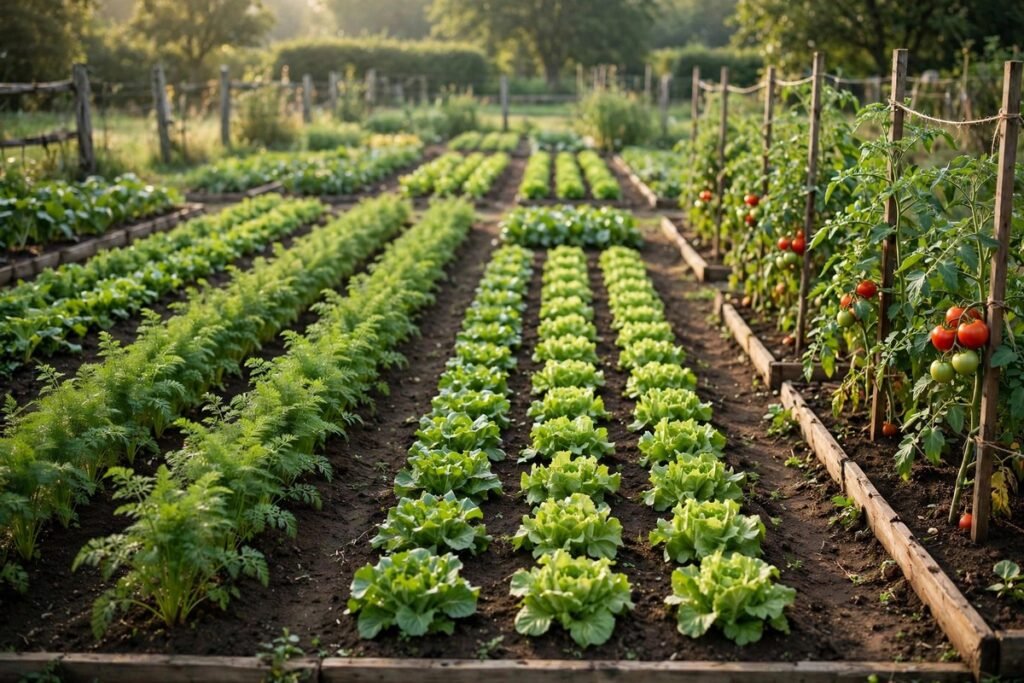
A 4×8 bed holds 5 staked tomato plants, 10 broccoli plants, 64 leaf lettuce plants and 192 carrot plants, using the Cornell spacing in the chart below. Spacing is the distance between plant centres, not the size of the seedling on planting day, so plan for the full size plant you will harvest.
How to read this chart
Each crop has two numbers. The first is the gap between plants in the same row. The second is the gap between one row and the next. Both are measured centre to centre. A tomato at 18 inches in row and 48 inches between rows needs a rectangle 18 inches wide and 48 inches long. The chart uses the Cornell table for both numbers. Where Cornell gives a range, this article uses the wider end, so the count is conservative.
Use the Plant Spacing Calculator to run your own bed size, with spacing from the chart or from your seed packet, and add spares for failures.
The formula, with a worked example
The calculator uses this formula for a square grid: plants = floor(length / spacing) x floor(width / row spacing), and plants to buy = ceil(plants x (1 + spare %)). Floor means round down, because you cannot plant part of a plant.
The site example is a 2.4 x 1.2 m bed at 30 cm spacing: floor(240 / 30) = 8 along the length, and floor(120 / 30) = 4 across the width, so 8 x 4 = 32 plants. With 10 percent spares, the printed formula gives ceil(32 x 1.10) = ceil(35.2) = 36 plants to buy. The calculator page lists 35, which is 32 plus 3, so 10 percent rounded down.
A 4×8 bed at 12 inch spacing gives the same result: 8 x 4 = 32 plants, or 36 to buy with 10 percent spares. Triangular spacing shifts alternate rows by half a spacing. In a large area it fits about 15 percent more plants, but in a narrow bed the edges can cancel that out, so the site example fits 30 plants, not 32.
Vegetable plant spacing chart
All spacing is from Cornell, Table 1, Lets Get Ready to Garden. The 4×8 count is for one crop filling the whole bed, in a square grid. Length is 96 inches, width is 48 inches.
| Crop | Between plants in row | Between rows | Plants in a 4×8 bed |
|---|---|---|---|
| Tomato, staked | 18 inches, 45.7 cm | 48 inches, 121.9 cm | 5 |
| Peppers | 18 inches, 45.7 cm | 36 inches, 91.4 cm | 5 |
| Eggplant | 24 inches, 61.0 cm | 48 inches, 121.9 cm | 4 |
| Broccoli | 18 inches, 45.7 cm | 24 inches, 61.0 cm | 10 |
| Cabbage | 18 inches, 45.7 cm | 24 inches, 61.0 cm | 10 |
| Cauliflower | 18 inches, 45.7 cm | 24 inches, 61.0 cm | 10 |
| Brussels sprouts | 18 inches, 45.7 cm | 24 inches, 61.0 cm | 10 |
| Lettuce, leaf | 6 inches, 15.2 cm | 12 inches, 30.5 cm | 64 |
| Spinach | 3 inches, 7.6 cm | 12 inches, 30.5 cm | 128 |
| Swiss chard | 6 inches, 15.2 cm | 18 inches, 45.7 cm | 32 |
| Beets | 2 inches, 5.1 cm | 12 inches, 30.5 cm | 192 |
| Carrots | 2 inches, 5.1 cm | 12 inches, 30.5 cm | 192 |
| Radish | 1 inch, 2.5 cm | 6 inches, 15.2 cm | 768 |
| Onions, bulb | 4 inches, 10.2 cm | 12 inches, 30.5 cm | 96 |
| Garlic | 3 inches, 7.6 cm | 12 inches, 30.5 cm | 128 |
| Peas | 2 inches, 5.1 cm | 12 inches, 30.5 cm | 192 |
| Beans, snap bush | 3 inches, 7.6 cm | 24 inches, 61.0 cm | 64 |
| Cucumber | 6 inches, 15.2 cm | 36 inches, 91.4 cm | 16 |
| Squash, summer | 36 inches, 91.4 cm | 48 inches, 121.9 cm | 2 |
| Squash, winter | 48 inches, 121.9 cm | 60 inches, 152.4 cm | 0 |
| Potato, white | 12 inches, 30.5 cm | 36 inches, 91.4 cm | 8 |
| Sweet corn | 10 inches, 25.4 cm | 36 inches, 91.4 cm | 9 |
What the chart shows by crop group
Fruiting crops need the most room. A staked tomato gives 5 plants in a 4×8 bed, because floor(96 / 18) = 5 and floor(48 / 48) = 1. Peppers give the same count, 5, and eggplant gives 4. Some growers use the in row spacing in both directions for tomatoes, which gives 10 plants, but those plants will be tighter, with less airflow and smaller fruit. Buy spares: 5 tomato plants with 10 percent spares is 6 to buy, and 10 broccoli plants is 11 to buy.
Leafy crops earn their keep in a small bed. Leaf lettuce gives 64 plants, spinach gives 128, and Swiss chard gives 32. Broccoli, cabbage, cauliflower and Brussels sprouts each give 10 plants, at 18 inches in row and 24 inches between rows. Head lettuce is different: it needs about 12 inches in row, which gives 32 plants, not 64, so check the variety on the packet.
Root crops are sown close in the row and wider between rows, because the row gap is where you walk, weed and thin. Carrots and beets each give 192 plants, radish gives 768, onions give 96, and garlic gives 128. Do not use the in row spacing in both directions for root crops, or the roots will be crowded, thin and hard to pull.
Legumes and sprawling crops need support or room to run. Snap bush beans give 64 plants and peas give 192, and peas need support or the vines will fall across the rows. Cucumber gives 16 plants, and that count is for plants, not vine length, so trellis it. Summer squash gives 2 plants, and one healthy plant feeds a household for weeks. Winter squash gives 0, because floor(48 / 60) = 0, so a 4 foot wide bed cannot hold even one traditional row. Pole beans are not in the Cornell table used here, so no count is given for them. Use the spacing on the seed packet, and a trellis. Sweet corn gives 9 plants, but corn needs a block of at least four rows for good pollination.
A mixed 4×8 bed, worked out
Split the bed by length, then count each part on its own. Take a 4×8 bed, split it into two 4×4 halves, with leaf lettuce in the first half and carrots in the second. Lettuce half: floor(48 / 6) = 8 along the length, and floor(48 / 12) = 4 rows, so 8 x 4 = 32 plants. Carrot half: floor(48 / 2) = 24 along the length, and floor(48 / 12) = 4 rows, so 24 x 4 = 96 plants. The bed holds 32 lettuce plants and 96 carrot plants, 128 plants in total.
For planning by household, work the other way round. Decide how many plants you need first, then work out the bed space. The site guide on how many vegetable plants per person plans by servings, not by a fixed chart. For a square foot layout, use the square foot garden planner.
Common mistakes with plant spacing
Using seedling size, not mature size. Space for the plant it becomes, not the plant you hold on planting day.
Using only one spacing number. A chart that lists tomato at 18 inches, with no row spacing, is only half a chart. The row gap decides how many rows fit.
Counting the edge as a planting spot. Each plant sits half a spacing in from the edge, which is why a 96 inch row at 18 inch spacing holds 5 plants, not 6.
Planting corn in a single row. Corn is wind pollinated, and a single row pollinates poorly. Grow corn in a block of at least four rows.
Expecting triangular rows to fit more plants in a narrow bed. They fit more in a large area, about 15 percent more, but in a 4 foot bed they can fit fewer, 30 instead of 32. Run both layouts in the calculator before you choose.
Sowing root crops in a tight grid. Carrots and beets need the row gap for thinning and pulling. A 2 inch grid in both directions gives thin, tangled roots.
FAQs
Q: How many tomato plants fit in a 4×8 bed?
A: Five staked tomato plants, at 18 inches in row and 48 inches between rows. That is floor(96 / 18) = 5 and floor(48 / 48) = 1. Buy 6 plants with 10 percent spares.
Q: How many lettuce plants fit in a 4×8 bed?
A: Sixty four leaf lettuce plants, at 6 inches in row and 12 inches between rows. That is 16 x 4. Head lettuce needs about 12 inches in row, which gives 32 plants, so check the variety on the packet.
Q: How many carrot plants fit in a 4×8 bed?
A: One hundred and ninety two carrot plants, at 2 inches in row and 12 inches between rows. That is 48 x 4. Thin to 2 inches after germination, or the roots will stay thin.
Q: Is triangular spacing better than square spacing?
A: In a large open area, yes, it fits about 15 percent more plants. In a narrow bed, no, the edges can cancel that out. The site example fits 30 plants in triangular rows, against 32 in a square grid.
Q: Can I plant closer than the chart says?
A: Yes, in rich soil you can reduce spacing slightly, but plants will be smaller and more prone to disease. The chart is for healthy, full size plants in good soil. Closer spacing is a trade off, not a free gain, so try it on one row first.
Q: What spacing should I use if my seed packet disagrees with the chart?
A: Use the seed packet. The packet is for your exact variety, and varieties differ. Use the chart to plan, and the packet to plant.
Use the chart to choose a spacing, run your bed size through the Plant Spacing Calculator, add spares, and plant to the packet for your variety. For more guides, browse the garden guides.
More guides

Head to Head Coverage Explained: Spacing, Corners, Edges and Middle
Head to head coverage means each sprinkler head sprays far enough to reach the head next to it, so the distance between…
Read guide
How Many Sprinkler Heads Do I Need
How many sprinkler heads do I need depends on lawn size and throw radius. A 10 by 6 metre lawn with 4…
Read guide
Sprinkler Calculator: A Worked Guide
A sprinkler calculator gives a head count and a zone count from lawn size and spray distance. For a 10 by 6…
Read guide