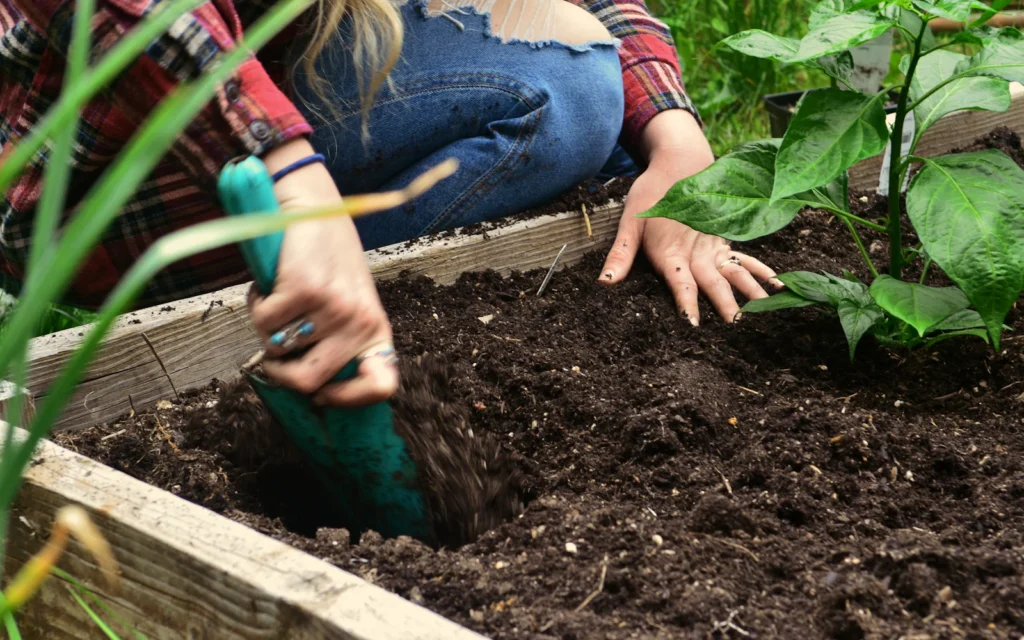
Look up how far apart to plant tomatoes and you can find answers from 18 inches to 4 feet. Both are right. The difference is layout: Cornell Cooperative Extension’s chart for staked tomatoes in traditional rows uses 18 inches between plants but 48 inches between rows, while a raised bed with no paths can use about 18–24 inches in every direction. Most spacing confusion comes from mixing these two systems.
This guide gives research-based spacings, explains how row, bed and grid layouts change the numbers, and shows how to work out how many plants you need. To lay out your own bed, use our plant spacing calculator.
Row spacing and in-row spacing are different numbers
Traditional charts give two figures: the distance between plants in a row and the distance between rows. The between-row figure includes room to walk, hoe or run a tiller. In a raised bed you reach from the sides, so you do not need that walking space, and plants can sit closer in every direction, usually at about the in-row spacing.
Recommended spacing for common vegetables
These figures come from Cornell’s recommended spacing and expected yields for New York gardens, a good general reference for temperate climates:
| Crop | In the row | Between rows | Expected yield per 10 ft of row |
|---|---|---|---|
| Tomato (staked) | 18 in | 48 in | 70–140 lb |
| Pepper | 18 in | 36 in | 30 lb |
| Potato | 12 in | 36 in | 20–30 lb |
| Cabbage | 12–18 in | 24 in | 15 lb |
| Broccoli | 12–18 in | 24 in | 12 lb |
| Sweet corn | 8 in | 24 in | 15 ears |
| Bush beans | 3–4 in | 24 in | about 8 lb |
| Cucumber (trellised) | 6 in | 24 in | 80 fruit |
| Summer squash | 24 in | 48 in | 20–25 fruit |
| Carrot | 2 in | 12 in | 8 lb |
| Beet | 2–3 in | 12 in | 12 lb |
| Spinach | 3 in | 12 in | 5 lb |
| Onion (bulb) | 3–4 in | 6 in | 30–40 bulbs |
| Garlic | 6 in | 12 in | 20 bulbs |
Our crop spacing calculator loads typical spacings for 14 crops and shows how many fit your bed.
Three layouts and how they change the plant count
Traditional rows
Best for large plots and mechanical cultivation. Uses the most space per plant because of the paths between rows.
Wide beds
Permanent beds about 3–4 ft (1–1.2 m) wide with paths between them. Plants go in short rows across or along the bed at close to in-row spacing, roughly doubling the number of plants per area compared with single rows.
Grid and square-foot planting
Plants sit at equal distances in every direction. Square-foot gardening divides a bed into one-foot squares: one tomato or pepper per square, four lettuces, nine bush beans or sixteen carrots. Our square foot garden planner builds the layout.
Offset (triangular) spacing fits about 15% more
Staggering each row by half a space keeps every plant the same distance from its neighbours while fitting the rows closer together, by a factor of 0.866. Over a bed that adds roughly 15% more plants with no extra crowding.
How to calculate plants per area
Plants per square foot = 144 ÷ (spacing between plants in inches × spacing between rows in inches)
For a whole field, Rutgers’ extension tables use the equivalent: 43,560 square feet in an acre divided by the area each plant occupies. Rows 36 inches apart with plants every 12 inches give 43,560 ÷ (3 × 1) = 14,520 plants per acre. Use the plants per acre calculator for orchards and fields, or the plant population calculator for row crops.
When to plant closer, and when not to
Closer spacing raises yield per square foot but lowers yield per plant, and it increases competition for water, nutrients and light. It works when soil is rich and well watered. Give more space when:
- soil is poor or water is limited;
- the variety is large or vigorous (indeterminate tomatoes, vining squash);
- your climate is humid and disease such as mildew or blight is common, because crowded foliage stays wet;
- you want large individual fruits or heads rather than many small ones.
Leafy crops such as lettuce and spinach tolerate close spacing well, especially if you harvest outer leaves; fruiting crops rarely do.
Frequently asked questions
Why does my seed packet give a different spacing from this chart?
Packets usually assume traditional rows and the variety’s mature size. Use the packet for the specific variety and adjust for your layout.
How far apart should tomatoes be in a raised bed?
About 18–24 inches between staked or caged plants, with no extra row spacing needed if you can reach them from the sides.
Can I plant closer if I trellis?
Yes. Growing cucumbers, peas, pole beans and even squash vertically lets you reduce in-row spacing because the plants spread upward. Cornell’s chart uses 6 inches for trellised cucumbers. Plan supports with the trellis planner.
How do I thin seedlings to the right spacing?
Sow a little thicker than the final spacing, then cut (do not pull) the weaker seedlings at soil level once they have true leaves, leaving the strongest at the recommended distance.
Sources: Cornell Cooperative Extension, “Recommended Spacing and Expected Yield for Garden Vegetables in New York”; Rutgers NJ Vegetable Crops, “Plant Spacings and Populations”. Spacings vary by variety and region.
More guides

Head to Head Coverage Explained: Spacing, Corners, Edges and Middle
Head to head coverage means each sprinkler head sprays far enough to reach the head next to it, so the distance between…
Read guide
How Many Sprinkler Heads Do I Need
How many sprinkler heads do I need depends on lawn size and throw radius. A 10 by 6 metre lawn with 4…
Read guide
Sprinkler Calculator: A Worked Guide
A sprinkler calculator gives a head count and a zone count from lawn size and spray distance. For a 10 by 6…
Read guide